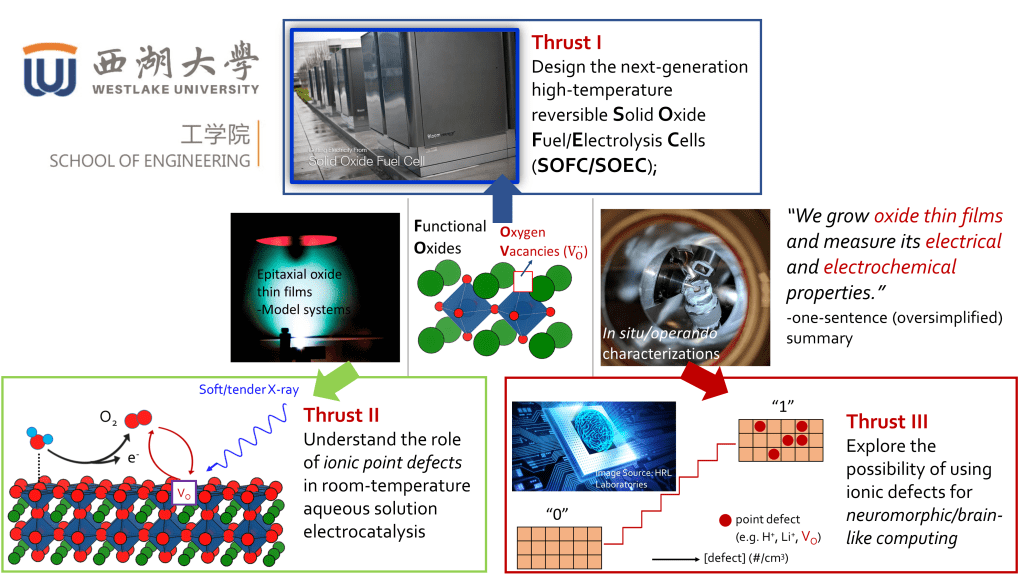


When Max Born looked back to his life’s work, he concluded: “I have restricted my work to ideal crystals though I am aware that the theory of the defects in real crystals is practically far more important. This I have left to a younger generation.” The Solid State Ionics Laboratory (Qiyang Lu’s group at Westlake University), undertakes the challenge posed by Born. Our focus centers on exploring the pivotal role of ionic point defects in shaping the properties and functionalities of oxide ceramics and thin films.

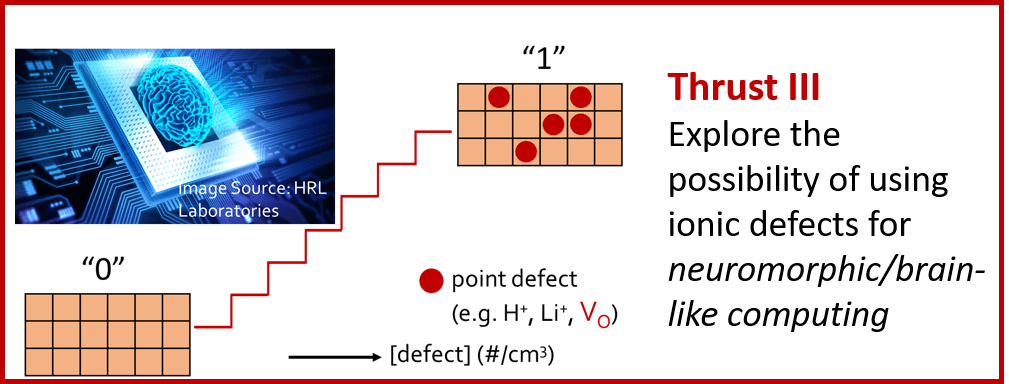
We identify important ionic defects (e.g., oxygen vacancies, protons, and lithium ions) as essential building blocks to enable tuning of physical (electrical, optical, magnetic, and thermal) and chemical (reactivity, stability and (electro-)catalytic) properties of functional oxides. Our research pursuits crystallize into two central thrusts, illustrated in the figure above. Towards the goal of establish the correlation between ionic defect concentration and property tuning ([def]~properties), we focus on a new high-throughput method to construct “phase diagrams”. Towards the goal of tuning properties, our interest lies in electrocatalysis (potential~[def]~properties), with a specific emphasis on unraveling the nuanced “dynamic” effects triggered by ionic point defects.
 Solid State Ionics Lab@Westlake University