Fall 2024 Solid State Ionics (Westlake University)

Course content:
Lecture 1-5: Ionic Defect Formation; Electronic Defects; Brouwer Diagram
Lecture 6-9: Ion Transport (Drift and Diffusion of Ionic Defects); Chemical Diffusion
Lecture 10-12: Potentiostatic/Galvanostatic Intermittent Titration Techniques (PITT/GITT)
Lecture 13-16: Stoichiometry Polarization; Blocking Electrodes; Chemical Capacitance
Lecture 17-19: Space Charge Layers (Gouy-Chapman Case and Mott-Schottky Case)
Lecture 20-21: Electrochemical Impedance Spectroscopy; Warburg Impedance
Video (on bilibili): https://space.bilibili.com/3546762329459250/lists/3963806?type=season
Fall 2023 Solid State Ionics (Westlake University)
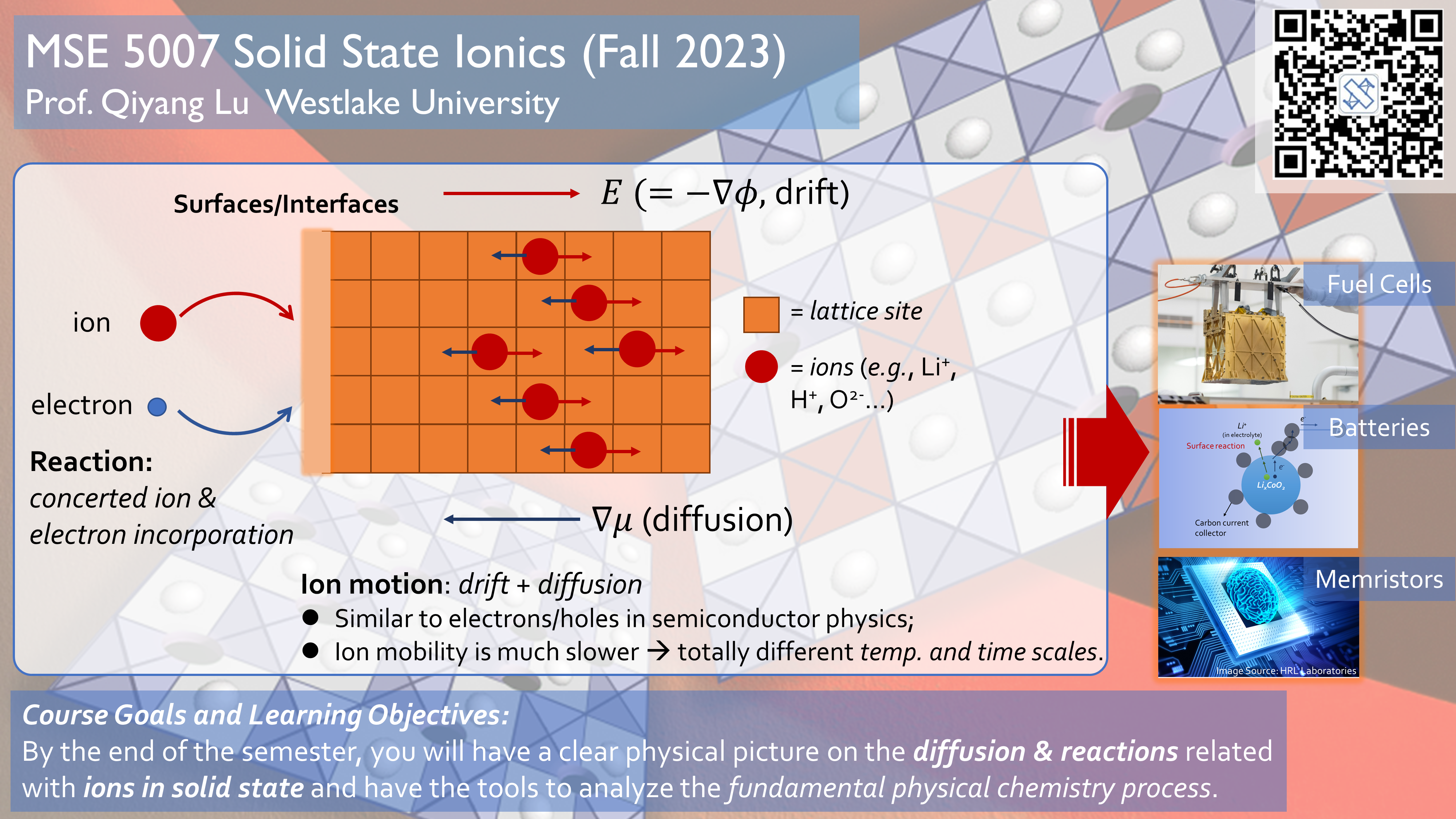
Course Materials:
Lecture 1: Course Introduction; Defect Formation download
Lecture 2: Brouwer Diagram download
Lecture 3: Ion Transport-Macroscopic Picture download
Lecture 4: Ion Transport-Microscopic Picture download
Lecture 5: Chemical Diffusivity download
Lecture 6: Stoichiometry Polarization download
Lecture 7: Space Charge Layers download
Lecture 8: Impedance Spectroscopy download
Lecture 9: Solid-State Electrochemistry I: Open-Circuit Potential download
Lecture 10: Solid-State Electrochemistry II: Kinetics; Butler-Volmer Equation; Frumkin Correction download
Homework problem sets:
HW1: Defect chemical equilibrium download;
HW2: Chemical diffusion and space charge layer download;
HW3: Solid-state electrochemistry download.
Fall 2022 Solid State Ionics (Westlake University)
Course description: This course serves as a comprehensive introduction to the fundamental knowledge and methodology in the field of solid state ionics. Solid state ionic materials have wide applications in energy conversion and storage, catalysis, sensing, as well as neuromorphic computing and memory. This course will introduce the underlying principles of ionic point defect behavior that governs the performance of solid ionic materials in these applications. These principles include point defect formation and defect chemical reactions, ion transport, migration and chemical (ambipolar) diffusion, solid-state electrochemistry, electrocatalysis and irreversible thermodynamics. Solid-state electrochemical techniques, frontiers in solid state ionics and case studies will also be discussed in this course.
Reference Books/Materials:
1. Physical Chemistry of Ionic Materials: Ions and Electrons in Solids (Second Edition) by J. Maier;
2. The Defect Chemistry of Metal Oxides by D. M. Smyth;
3. Defects and Transport in Crystalline Solids by P. Kofstad and T. Norby;
4. Electrochemical Methods: Fundamentals and Applications by Allen J. Bard, Larry R. Faulkner and Henry S. White
Course Materials:
Lecture 1: Course Introduction download
Lecture 2: Brouwer Diagram download
Lecture 3: Ion Transport-Macroscopic Picture download
Lecture 4: Ion Transport-Microscopic Picture download
Lecture 5: Chemical Diffusivity download
Lecture 6-7: Space Charge Layers download
Lecture 8: Impedance Spectroscopy download
Lecture 9: Solid-State Electrochemistry I: Open-Circuit Potential download
Lecture 10: Solid-State Electrochemistry II: Kinetics; Butler-Volmer Equation download
Lecture 11-12: Solid-State Electrochemistry III: Frumkin Correction and Marcus Theory download
Lecture 13: Chemo-Mechanical Coupling download
Lecture 14: Review and Homework Solutions download
Homework problem sets:
There were three problems sets with some problems originated from research papers. I designed these problems so that students can practice how to apply knowledge learned in lectures to real-world problem solving.
HW1: Defect chemical equilibrium download;
HW2: Chemical diffusion and space charge layer download;
HW3: Solid-state electrochemistry download.
Special thanks: Prof. Chia-Chin Chen (National Taiwan University); Prof. Donglin Han (Soochow University); Prof. Yanhao Dong (Tsinghua University); Prof. Min Chen (Foshan University)
 Solid State Ionics Lab@Westlake University